Quick Summary: A destination wedding in Belize or Tulum typically costs $10,000 to $30,000 for the wedding itself, not including guest travel. Most couples are surprised because the package price they found online is just the starting point. Guest count is the single biggest cost driver. This post breaks down exactly where the money goes, what your resort package actually covers, and the line items that appear after you’ve already signed.
After helping over 1,000 couples plan destination weddings across Belize and Tulum, the first question we hear in almost every consultation is some version of: “What is this actually going to cost us?” It’s the right question to ask. And the honest answer is that the number on the resort website is not the number you’re going to spend.
Most couples start with a package price they found online, feel relieved it’s manageable, and then spend the next three months watching the estimate climb. Per-person overages. Taxes added after the fact. Lighting packages that weren’t included. A sound system nobody mentioned. By the time the final invoice arrives, a $3,500 wedding package has become $6,000 or more.
That gap isn’t a scam. It’s just how resort wedding pricing works. And once you understand the structure, the numbers stop being surprising. More importantly, you can actually plan for them.
This guide covers what a destination wedding actually costs by tier, what your resort package includes (and what it doesn’t), how guest count drives the total more than any other single decision, how Belize and Tulum compare on budget structure, and the six questions to ask before you sign anything.
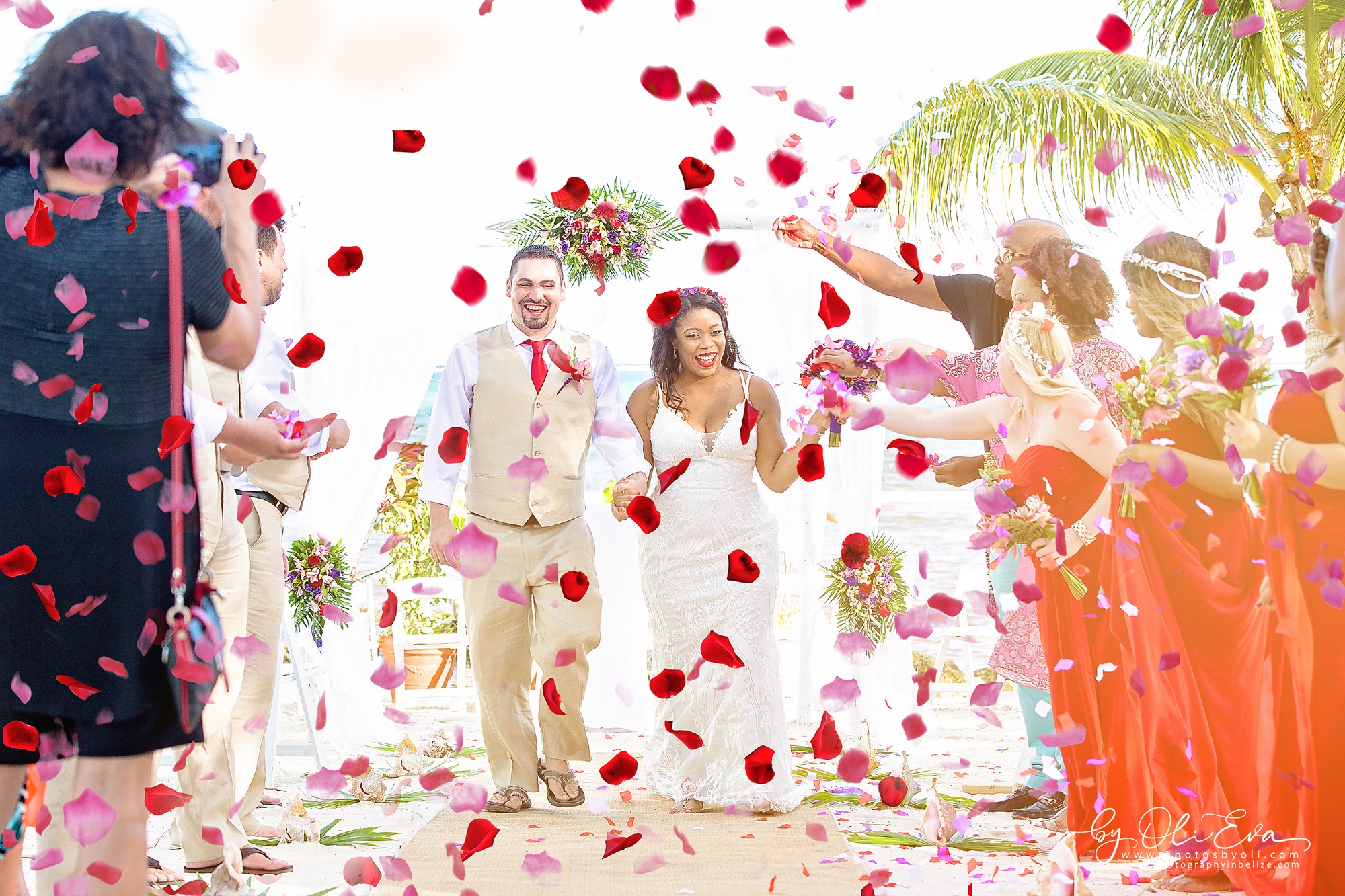
How Much Does a Destination Wedding Actually Cost?
For Belize and Tulum, a destination wedding for 30 to 65 guests typically runs $10,000 to $30,000 for the wedding itself. That covers the ceremony, reception, decor, and photography. Guest flights and accommodation are separate. The US average for a traditional wedding hit $34,200 in 2025, according to The Knot 2026 Real Weddings Study, making a well-planned destination wedding a real saving for most couples.
Here’s how the cost tiers break down:
| Tier | Total Cost Range | Guest Count | What It Covers |
| Budget | $5,000 – $10,000 | Under 30 guests | Base package, minimal upgrades, symbolic ceremony |
| Mid-range | $10,000 – $20,000 | 30 – 50 guests | Private reception, photographer, upgraded decor, DJ |
| Premium | $20,000 – $35,000 | 50 – 65 guests | Full build-out: lighting, premium florals, private venue, full photography |
For context: the average destination wedding at an all-inclusive resort runs about $9,850, according to real couple data from DestinationWeddings.com. That’s the package cost, not including the couple’s own travel or accommodation. It also doesn’t include upgrades, which is where most budgets grow.
What’s Actually Included in a Resort Wedding Package?
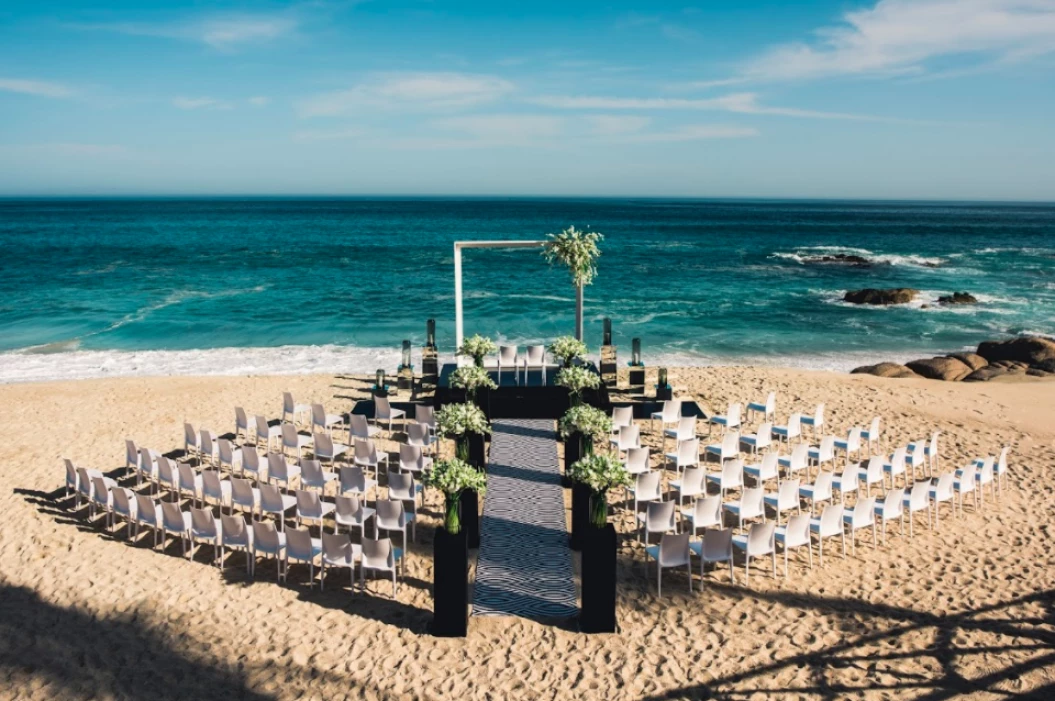
A standard resort wedding package covers the ceremony venue, white folding chairs, a basic arch, a bridal bouquet and boutonniere, a wedding cake, a champagne toast, an officiant, and an on-site coordinator. That’s it at the base tier. Everything else is an add-on. See our full breakdown of what’s actually in a Tulum wedding package.
Here’s the clearest way to understand the distinction:
What base packages include:
- Ceremony venue (hotel’s choice, not always yours)
- White folding chairs for guests
- Basic arch or floral frame
- One bridal bouquet and one boutonniere
- Wedding cake
- Champagne toast
- Bilingual officiant
- On-site coordinator for ceremony day
What base packages do NOT include:
- Photography — included at some tiers, add-on or not included at base
- DJ or music — almost always a separate line item starting at $1,500
- Lighting — string lights, Edison bulbs, uplighting: $500 to $2,000
- Dance floor — separate rental
- Upgraded chairs — bamboo or Chiavari at $8 to $10 per chair
- Centerpieces beyond the sweetheart table — $45 to $95 per table baseline
- Outside vendor access fees — $500 to $1,500 per vendor
- Beach ceremony fee — a separate permit or venue charge at most Mexico resorts
One important distinction: “all-inclusive” for the resort stay and “all-inclusive” for the wedding package are two separate things. Your guests’ food and drinks during their stay are covered by their room rate. The wedding package covers the event setup. They are not the same line item.
The Costs That Don’t Show Up in the Quote
This is the section that changes most budgets. These aren’t surprises the resort is hiding. They’re standard line items that don’t appear in the headline package price and that couples don’t know to ask about.
1. Per-person overage fees. Every package covers a set number of guests, usually 20 to 30 people. Go above that number and you pay a per-person fee for every additional guest. These fees typically run $50 to $150 per person depending on the resort and menu. On a 55-person wedding with a package covering 30, that’s 25 people at $100 each: $2,500 in overages before you’ve changed a single detail.
2. Taxes and service charges. Most resorts list pre-tax prices. Local taxes and service charges add 10 to 25% to the package total. A real example: a couple we spoke with booked a $3,500 package that became $4,100 before they had selected a single upgrade, just from taxes alone.
3. Lighting upgrades. The string lights in every Tulum wedding photo? Those are a line item. Lighting setup and labor runs $500 to $2,000 depending on the space. It’s not decorative. It’s the difference between photos that look like the inspiration board and photos that look flat.
4. Outside vendor access fees. Bring in a photographer, DJ, or florist not on the resort’s approved list and most properties charge an access fee. These fees run $500 to $1,500 per vendor. Some resorts also require outside vendors to book a room for the event period.
5. Beach ceremony fees. Getting married on the beach in Mexico requires a separate permit or venue charge at most resorts. It’s not bundled into the standard ceremony package.
6. Overtime charges. Vendors are contracted for a set window. If the reception runs long, overtime starts at around $250 per hour. Build extra time into your booking upfront.
The practical rule: add 15 to 20% to whatever the package quote says, and treat that as your real floor, not the package price itself.
How Does Guest Count Drive Your Total Cost?
Guest count is the single biggest cost driver in a destination wedding. More than the destination. More than the resort tier. Every guest above your package limit adds a per-person fee. Moving from 40 to 70 guests doesn’t just scale costs proportionally. It can push you into a different package tier and add $3,000 to $5,000 in overages before a single upgrade.
When couples ask us how to keep a destination wedding under a specific budget, our first question is always the same: what’s your guest count?
If you plan for 40 and your final headcount is 75, you’re no longer in the same wedding. The venue choices change. The package tier changes. The overage math changes everything downstream. We’ve seen couples go from a $12,000 all-in estimate to $20,000 simply by not locking in their guest count early.
Lock in a realistic guest count before you fall in love with a venue. That number controls every other number.
Belize vs. Tulum: How Destination Affects Your Budget
Your destination choice shapes the financial structure of your wedding. Here’s how they compare across the factors that matter most to your budget.
| Factor | Belize | Tulum |
| Property type | Boutique, independent resorts; more a-la-carte | Mix of large all-inclusive and boutique; packages more standardized |
| Wedding cost range | $10,000 – $30,000+ | $9,000 – $30,000+ (all-in for 50 guests: $25,000 – $35,000) |
| Food & drink structure | Often EP; you pay per person for reception food and drink separately | All-inclusive options mean guests’ room rates subsidize the reception bar |
| Decor costs | More a-la-carte; natural backdrops reduce need for heavy decor | Jungle setting does the work; less decor spending than a blank venue |
| Local sourcing | Limited imported ingredients; destination rewards couples who work with it | Similar; if you need asparagus on every plate, both destinations will push back on cost |
For Tulum specifically, all-inclusive properties like Hilton Tulum, Secrets Tulum, and Dreams Tulum are the most financially efficient choice. At an all-inclusive, your guests have already paid for food and drinks through their room rate. At your reception, the hotel provides that same service without charging you a separate per-person catering fee. That single structural advantage saves most couples $5,000 to $8,000 compared to an EP property.
For a full breakdown of what 50 guests costs in Tulum across every line item, see our detailed Tulum wedding cost guide. For Belize properties and what they include, browse the resorts we work with and how their packages are structured.
When Does a Destination Wedding Actually Save You Money?
A destination wedding saves money under three specific conditions: your guest list is intentional (30 to 60 people), you choose an all-inclusive property, and you book shoulder season. The US wedding average hit $36,000 in 2025. A comparable Belize or Tulum wedding for 50 guests at an all-inclusive typically runs $15,000 to $25,000. The saving is real, but it depends on these three decisions.
The three conditions in detail:
- Intentional guest list. The reception accounts for roughly 60% of most wedding budgets. Fewer guests means dramatically lower per-person costs. Destify’s analysis of over 100 destination weddings found the majority saved significantly compared to a comparable US event precisely because guest lists were smaller and more deliberate.
- All-inclusive property. At an all-inclusive, guests pay for food and drinks through their room rate. Your reception doesn’t carry a separate catering bill. At an EP property, you pay $100 to $150 per person for a reception dinner, plus a separate bar package. For 50 guests, that’s $5,000 to $7,500 in catering alone before anything else. The all-inclusive structure eliminates that line item. See why we always recommend all-inclusive for the full argument.
- Shoulder season booking. Shoulder season savings of 25 to 40% are real and consistent. In Tulum, that means late April through early June. The weather is still genuinely good. The price difference is meaningful. If your date is flexible, this is one of the most effective budget levers available.
What to Ask Before You Sign Anything
Most of the budget surprises we help couples navigate could have been avoided at the contract stage. These six questions apply to every resort and every destination.
- How many guests does the base package cover, and what is the per-person rate above that number? This is the most important number in the quote. Get it in writing.
- Are taxes and service charges included in the quoted price? Always ask for the all-in number, not the base package price.
- Is the beach ceremony included, or is there a separate fee? At most Mexico resorts, getting married on the beach is a separate line item.
- What is the policy on outside vendors, and what are the access fees? Know the cost before you fall in love with a photographer who isn’t on the approved list.
- Can we choose our ceremony venue, or does the hotel assign it? Standard packages at many resorts give the hotel the right to assign your space. If the specific location matters to you, confirm it’s locked in contractually.
- When will the on-site coordinator begin active planning? Most resorts don’t start finalizing wedding details until about 90 days before the date. That’s completely normal. But couples who don’t know this often panic when the inbox goes quiet in month six. Ask the question upfront so you’re not reading into the silence.
If you’re working through these questions across three or four properties at once, that’s exactly what the first consultation with us covers. We know what each resort’s answers look like before you ask.
Three things to take from this post: the package price is a floor, not a ceiling. Guest count controls your budget more than any other single decision. And working with planners who have been inside these venues means you don’t have to figure out the fine print from a contract alone.
We’ve planned Tulum and Belize weddings at almost every budget level. We know where the money goes, what’s worth spending on, and what most couples regret overpaying for. We’ll give you a real number in the first conversation, not a range, not a starting from.
Book a free consultation and we’ll give you the honest picture from the start.
Frequently Asked Questions
How much does a destination wedding in Belize cost?
A destination wedding in Belize typically runs $10,000 to $30,000 for the event itself. Most Belize resorts operate on a European Plan model, meaning food and drinks at the reception are charged separately per person. Budget-level weddings for under 20 guests at mid-range properties start around $5,000 to $10,000, while premium experiences at properties like Las Terrazas or Alaia Belize for 40 to 60 guests push toward $30,000 and above.
How much does a destination wedding in Tulum cost?
For 50 to 65 guests, a Tulum destination wedding runs $25,000 to $35,000 all in for the wedding itself. All-inclusive packages at Hilton Tulum, Secrets Tulum, or Dreams Tulum average around $6,500 for 50 guests at the package level. A fully built-out wedding with photography, DJ, upgraded decor, and lighting typically runs $16,000 to $24,000 before taxes and service charges. For a complete line-by-line breakdown, see our Tulum wedding cost guide for 50 guests.
Does the package price include guest accommodation and flights?
No. Resort wedding packages cover the wedding event: the ceremony setup, venue, and listed inclusions. Guest accommodation and flights are separate costs each guest handles individually. Room block rates are negotiated as a group to give guests a discounted nightly rate, but those costs are not part of the wedding package. The average guest spends $1,795 to $2,195 total for a five-night destination wedding trip including accommodation, meals, and drinks at an all-inclusive.
What are the most common hidden costs in destination wedding packages?
The most common costs that don’t appear in the initial quote are: per-person overage fees when your guest count exceeds the package limit (typically $50 to $150 per additional guest), taxes and service charges of 10 to 25% on top of the package total, lighting upgrades ($500 to $2,000), outside vendor access fees ($500 to $1,500 per vendor), beach ceremony permits, and overtime charges starting at $250 per hour. Planning experts recommend budgeting 15 to 20% above the quoted package price to account for these line items.
Is a destination wedding cheaper than a traditional US wedding?
For most couples planning a wedding of 30 to 60 guests, yes. The US wedding average hit $36,000 in 2025, and a comparable event at a US venue with catering and photography for 50 guests realistically runs $50,000 to $60,000. A similar wedding in Tulum runs $25,000 to $35,000. The saving is real, but it depends on an intentional guest list, an all-inclusive property, and understanding what the package does and doesn’t include before you commit.