Summary: At an all-inclusive resort, your guests have already paid for food and drinks through their room rate. At your reception, the hotel provides that same service — meaning the biggest single line item in most wedding budgets is effectively covered by your guests’ own accommodation. This post explains exactly how all-inclusive wedding packages work, why they almost always cost less than European Plan alternatives, and the handful of situations where a boutique EP property is worth it anyway.
We’ve looked at the all-inclusive vs. EP comparison across hundreds of destination weddings. The recommendation isn’t a preference. It’s a financial argument with a clear answer almost every time.
Here’s what happens without it. A couple finds a stunning boutique property in Tulum. The room rates are lower than the big all-inclusive resorts. The aesthetic is exactly what they wanted. They fall in love. Then the wedding proposal comes back, and the per-person catering fee for 50 guests is $150 each. Plus a separate bar package. Plus setup. Plus taxes. Before they’ve added a single upgrade, a 100-guest wedding at a European Plan resort in the Riviera Maya runs $60,000 to $80,000 — nearly the same as a US wedding, but on a beach.
We tell couples this upfront, not to steer them away from boutique properties entirely, but because the comparison has to start with the real numbers. There are situations where a European Plan property is the right call. But they’re specific, and most couples don’t fit them.
This post covers how all-inclusive wedding packages actually work, the math behind why the total is almost always lower, what’s included in the package vs. what’s not, the guest experience argument, and the honest situations where EP makes sense anyway.
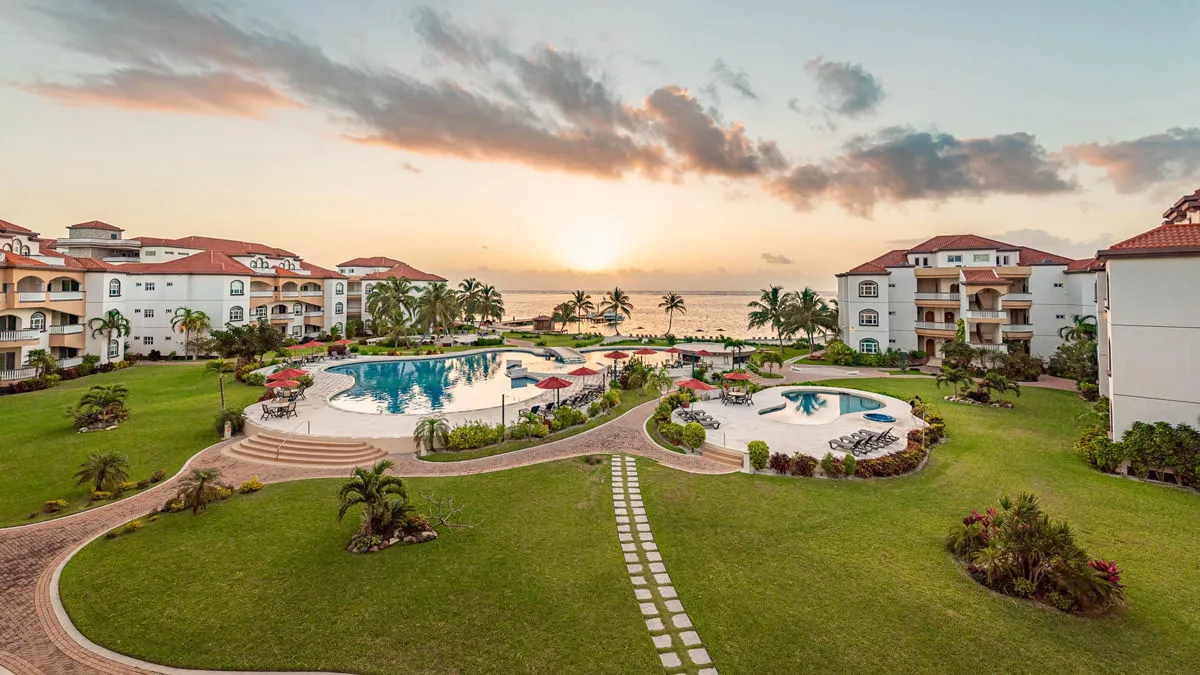
What Does “All-Inclusive” Actually Mean for a Wedding?
At an all-inclusive resort, guests pay one nightly rate covering accommodation, all meals, alcoholic and non-alcoholic drinks, and most resort activities. A true all-inclusive plan includes all taxes, resort fees, gratuities, meals, and drinks in that single rate. For a wedding, this means food and drink at your reception are not a separate charge. They’re covered by the same rate your guests already paid to stay. The wedding package is a separate purchase layered on top, covering event-specific elements like the ceremony setup, private venue, and coordination.
Two things are happening financially when you host a wedding at an all-inclusive resort:
Your guests’ room rate covers their food and drinks throughout the trip, including at your reception. The hotel is providing the same catering service they were already providing. You are not charged a separate per-person fee for guests to eat and drink at your wedding.
Your wedding package covers the event setup — the ceremony venue, arch, chairs, coordinator, cake, champagne toast, and whatever is listed in the package tier you booked. This is a separate line item from the resort stay, and it’s where add-ons and upgrades happen.
These two things are frequently confused. When couples ask if a destination wedding is “all-inclusive,” what they really need to understand is that the reception food and drink are handled by the first bucket, and the ceremony setup is handled by the second. Explore the all-inclusive resorts we work with to see how this plays out across specific properties.
The Open Bar Math: Why All-Inclusive Saves You Money
The reception accounts for roughly 60% of most wedding budgets. Food, drinks, catering staff, and the open bar. It’s the single biggest cost category in any wedding, destination or otherwise. The all-inclusive model eliminates it as a separate charge.
Here’s what the comparison looks like for 50 guests in Tulum:
| Cost Category | European Plan (EP) | All-Inclusive |
| Base wedding package | $3,000 – $6,000 | $6,500 avg for 50 guests |
| Reception dinner (per person) | $100 – $150 x 50 = $5,000 – $7,500 | Covered by guests’ room rates |
| Open bar (4 hours) | $2,000 – $5,000 separate package | Covered by guests’ room rates |
| Taxes and service charges | 10 – 25% on package + catering | 10 – 25% on wedding package only |
| Realistic total (before upgrades) | $12,000 – $22,000+ | $7,500 – $10,000 |
At scale, the gap is even more striking. A 100-guest wedding at a European Plan resort in the Riviera Maya typically runs $60,000 to $80,000. The same guest count at an all-inclusive runs $20,000 to $40,000. That’s not a small optimization. That’s a structurally different outcome driven by one variable: who pays for the open bar.
At a traditional US wedding, the average open bar for 100 guests runs $1,800 to $2,400 for a standard package and $3,000 to $4,800 for premium spirits. That’s before the catering bill. At an all-inclusive resort, your guests paid for both when they booked their room. You’re not double-paying for what they’ve already bought.
For a detailed look at what this means for a specific Tulum wedding, see our full cost breakdown for 50 guests in Tulum, which walks through every line item from the base package through photography and lighting.
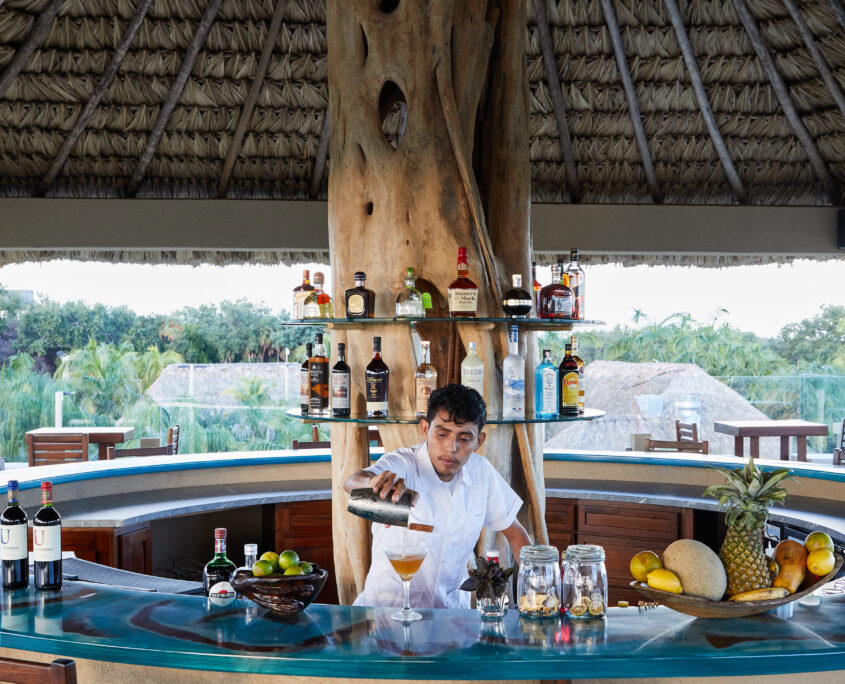
What’s Actually Included in an All-Inclusive Wedding Package?
A base all-inclusive wedding package covers: ceremony venue, white folding chairs, a basic arch, a bridal bouquet and boutonniere, a wedding cake, a champagne toast, a bilingual officiant, and an on-site coordinator. The resort’s all-inclusive plan (covering your guests’ meals and drinks throughout their stay) is separate. Photography, DJ, upgraded florals, lighting, dance floor, and outside vendor fees are almost always add-ons at every package tier.
What the base package includes:
- Ceremony venue (hotel’s choice at base tier, lockable at higher tiers)
- White folding chairs for guests
- Basic arch or floral frame
- Bridal bouquet and groom’s boutonniere
- Wedding cake
- Champagne toast
- Bilingual officiant
- On-site wedding coordinator (day-of logistics at the resort)
What is almost always an add-on, regardless of resort:
- Photography — included at some mid and upper tiers, add-on or not included at base
- DJ or live music — separate line item starting around $1,500
- Upgraded lighting — string lights, Edison bulbs, uplighting: $500 to $2,000
- Dance floor — separate rental at most properties
- Upgraded chairs — bamboo or Chiavari: $8 to $10 per chair
- Outside vendor access fees — $500 to $1,500 per vendor for non-approved vendors
- Beach ceremony permit fee — separate at most Mexico resorts
For a full breakdown of what each tier includes and what gets added, see our guide on what’s actually included in a Tulum wedding package. The same structure applies across Mexico and Belize all-inclusive properties.
The Guest Experience Is Better Too
The financial case is the clearest argument, but it’s not the only one.
At an all-inclusive resort, your guests arrive on a Tuesday, eat breakfast, spend the day at the pool or beach, have lunch, get ready for your wedding, attend the ceremony, go to the reception, drink and eat and dance, and go to bed. At no point in that sequence do they open their wallets.
At a European Plan property, the meter is running the whole time. Dinner at the resort restaurant: $60 per person. Drinks at the pool bar: $15 each. Cocktail hour at the reception: $75 to $150 per day in food and drinks just for the stay, not including the wedding itself. Some guests budget for it and are fine. Others feel the pressure, skip meals, decline optional events, or spend the trip quietly calculating what they’re spending.
“You’re already asking people to take time off work, book flights, and travel internationally. At an all-inclusive, you’re treating that investment as a gift — they arrive, everything is handled, and the focus is entirely on the celebration. At an EP property, there’s a financial texture to the whole trip that changes the energy. It’s not always a problem. But it’s a real thing, and it affects how present your guests are.” — Rachel, Signature Destination Weddings
The all-inclusive model also produces a more cohesive group experience throughout the wedding weekend. Your guests are at the same resort, eating at the same restaurants, on the same beach. The shared time before and after the wedding day builds connection in a way that’s harder to manufacture at an EP property where guests are scattered or managing their own costs throughout.
One more practical note: room block deposits at all-inclusive resorts are roughly $100 per room, compared to 20% of total contract revenue at EP properties. For a 40-room block at $100k contract value, that’s $4,000 vs. $20,000 upfront. The all-inclusive structure is financially friendlier at every stage of the process.
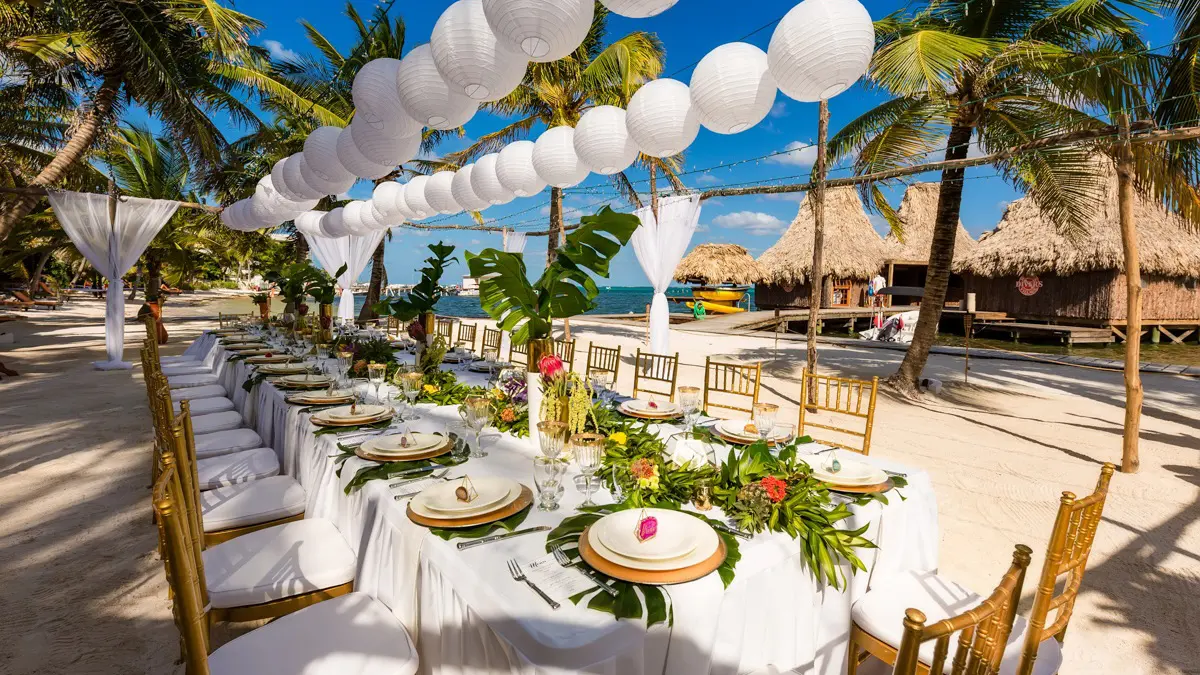
When Does a European Plan Property Make Sense?
European Plan boutique properties are the right choice in three specific situations: very small elopements of under 15 guests where per-person catering costs are minimal, couples who need something a specific boutique EP venue offers that no all-inclusive can replicate and who have accurately budgeted the full food and drink cost, and couples planning a wedding where most guests are not staying at the resort property. For everyone else, the all-inclusive total almost always wins.
The three situations where EP makes sense:
- Elopements and micro-weddings under 15 guests. At this scale, a per-person catering fee for 10 to 15 guests doesn’t dramatically change the math. The boutique intimacy of an EP venue may be worth the modest food and drink add-on.
- A specific boutique venue with something irreplaceable. Some EP properties in Tulum — certain cenote venues, private jungle estates, beachfront villas — offer something genuinely singular. If you’ve seen it, budgeted the full EP cost accurately (including per-person catering and a bar package on top), and the experience is worth the premium, the choice is valid. The mistake is making this decision before running the full numbers.
- Most guests are not staying at the property. Some boutique EP venues are rented as private event spaces where guests stay elsewhere. In this case, the per-person catering model applies regardless and the all-inclusive comparison doesn’t hold. If you’re renting a private villa for the event itself, the EP structure is how that market works.
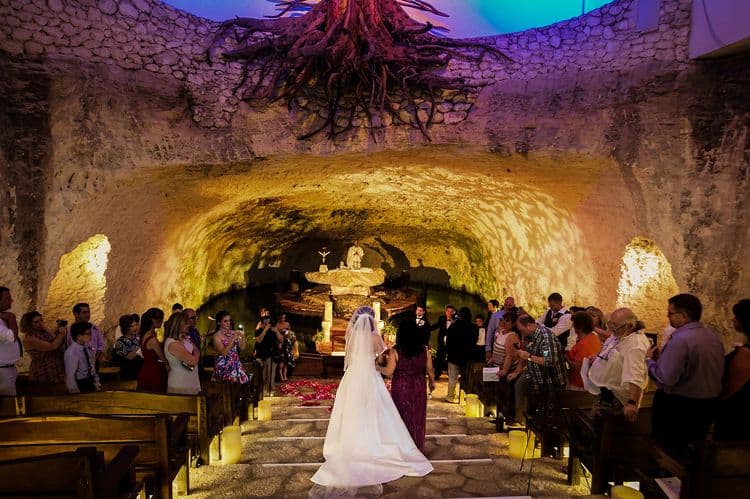
The Tulum boutique EP trap is a real pattern we see often: a couple falls in love with a property based on the photos and the room rate, skips past the per-person catering line in the fine print, and builds a budget from the wrong number. If you’re comparing a Tulum boutique EP property to an all-inclusive, run the total cost for your full guest count across both before making any decision. See our guide on planning a destination wedding in Mexico for how to structure that comparison correctly.
How to Compare All-Inclusive Wedding Packages Across Resorts
Most couples compare packages by headline price. That’s the wrong comparison point. Two packages priced at $6,500 can produce very different final bills depending on what’s bundled and what isn’t.
Six things to check before comparing any two packages:
- Guest count included and per-person overage rate. A package covering 30 guests at $6,500 is not the same as a package covering 50 guests at $6,500. Get the overage fee per additional guest in writing.
- Taxes and service charges. Most resorts add 10 to 25% in taxes and service charges on top of the package price. Always ask for the all-in number.
- Photography. Is it included at this tier, or is it an add-on? If it’s included, is it a set number of hours or full coverage?
- Ceremony venue choice. Can you choose your ceremony location at booking, or does the hotel assign it? At some resorts the best spaces are first-come, at others they’re tier-dependent.
- Weekday vs. weekend pricing. Saturday ceremony dates carry premium pricing at most resorts. The same package on a Thursday can be meaningfully cheaper.
- Outside vendor policy and fees. Bringing your own photographer or DJ? Check the access fee before you commit to anyone not on the approved vendor list.
Compare total costs, not headline prices. The package with the lower starting number is rarely the better deal once you account for what it doesn’t include.
The all-inclusive recommendation comes down to one structural fact: the reception is roughly 60% of most wedding budgets. At an all-inclusive resort, your guests have already paid for it through their room rate. That’s not a preference or a convenience argument — it’s math.
There are beautiful boutique EP properties that are worth the premium for the right couple with the right guest count and the right budget. But that decision has to start with the full numbers, not the room rate.
If you want to compare packages across the all-inclusive resorts we work with — and get a real number for your specific guest count and destination — book a free consultation and we’ll build the comparison with you.
Frequently Asked Questions
What is the difference between an all-inclusive resort stay and an all-inclusive wedding package?
They are two separate purchases. The all-inclusive resort stay covers your guests’ accommodation, all meals, alcoholic and non-alcoholic drinks, and most resort activities throughout their trip. The wedding package covers the event itself: the ceremony venue, setup, coordinator, cake, champagne toast, and whatever else is listed in the package tier. The financial advantage of an all-inclusive resort is that the first bucket (guests’ food and drinks) is already paid for through room rates, so the reception doesn’t generate a separate per-person catering bill on top of the wedding package.
How much does an all-inclusive destination wedding cost compared to a European Plan wedding?
The gap is significant at scale. A 100-guest wedding at a European Plan resort in the Riviera Maya typically runs $60,000 to $80,000 because food, drinks, and catering are charged separately per person. The same guest count at an all-inclusive runs $20,000 to $40,000 because guests’ room rates cover the reception food and drink. For 50 guests, the all-inclusive total before upgrades typically runs $7,500 to $10,000 vs. $12,000 to $22,000+ at an EP property. The average all-inclusive destination wedding costs $9,850 vs. $36,000 for a traditional US wedding.
What does a base all-inclusive wedding package include?
Base packages include the ceremony venue (at the hotel’s choice at entry tier), white folding chairs, a basic arch, a bridal bouquet and boutonniere, a wedding cake, a champagne toast, a bilingual officiant, and an on-site wedding coordinator. Photography, DJ, upgraded florals, lighting, dance floor, upgraded chairs, and outside vendor access fees are add-ons at almost every resort regardless of package tier. Always ask for the full inclusions list and the all-in price before comparing packages.
Can I still have a beautiful, personalized wedding at an all-inclusive resort?
Yes. The most common misconception about all-inclusive resort weddings is that they feel generic or mass-produced. The base package is the foundation, not the finished wedding. Every couple who works with us builds on that foundation with photography they love, lighting that transforms the space, florals that match their vision, and a reception that feels specific to them. The destination itself, whether Tulum’s jungle-meets-beach setting or a Belize beachfront property, does a significant amount of the decorative work. You’re not starting from a blank ballroom.
Are there situations where a European Plan resort is better for a destination wedding?
Yes, specifically three: very small elopements under 15 guests where the per-person catering cost is minimal, couples who need what a specific boutique EP venue offers and have budgeted the full food and drink cost accurately from the start, and weddings where most guests are not staying at the venue property. For most couples planning a 30 to 80 person destination wedding in Mexico or Belize, the all-inclusive total comes out lower once you run the full numbers across both options. The mistake is comparing headline package prices without accounting for what each one doesn’t include.